

The Serviceberry: Abundance and Reciprocity in the Natural World
by Robin Wall Kimmerer
GENRE: Nonfiction, Economics, Nature, Science
As Indigenous scientist and author of Braiding Sweetgrass Robin Wall Kimmerer harvests serviceberries alongside the birds, she considers the ethic of reciprocity that lies at the heart of the gift economy. How, she asks, can we learn from Indigenous wisdom and the plant world to reimagine what we value most?
Our economy is rooted in scarcity, competition, and the hoarding of resources, and we have surrendered our values to a system that actively harms what we love. Meanwhile, the serviceberry’s relationship with the natural world is an embodiment of reciprocity, interconnectedness, and gratitude. The tree distributes its wealth—its abundance of sweet, juicy berries—to meet the needs of its natural community. And this distribution ensures its own survival.
As Kimmerer explains, “Serviceberries show us another model, one based upon reciprocity, where wealth comes from the quality of your relationships, not from the illusion of self-sufficiency.”

Author Biography
Robin Wall Kimmerer is a mother, scientist, decorated professor, and enrolled member of the Citizen Potawatomi Nation. She is the author of The Serviceberry: Abundance and Reciprocity in the Natural World, Braiding Sweetgrass: Indigenous Wisdom, Scientific Knowledge and the Teachings of Plants, which has earned Kimmerer wide acclaim. Her first book, Gathering Moss: A Natural and Cultural History of Mosses, was awarded the John Burroughs Medal for outstanding nature writing, and her other work has appeared in Orion, Whole Terrain, and numerous scientific journals. In 2022, Braiding Sweetgrass was adapted for young adults by Monique Gray Smith. This new edition reinforces how wider ecological understanding stems from listening to the earth’s oldest teachers: the plants around us.
Robin tours widely and has been featured on NPR’s On Being with Krista Tippett and in 2015 addressed the general assembly of the United Nations on the topic of “Healing Our Relationship with Nature.” Kimmerer is a SUNY Distinguished Teaching Professor of Environmental Biology, and the founder and director of the Center for Native Peoples and the Environment, whose mission is to create programs which draw on the wisdom of both indigenous and scientific knowledge for our shared goals of sustainability. In 2022 she was named a MacArthur Fellow.
As a writer and a scientist, her interests in restoration include not only restoration of ecological communities, but restoration of our relationships to land. She holds a BS in Botany from SUNY ESF, an MS and PhD in Botany from the University of Wisconsin and is the author of numerous scientific papers on plant ecology, bryophyte ecology, traditional knowledge and restoration ecology. She lives on an old farm in upstate New York, tending gardens both cultivated and wild. - Author's website
Reviews
Publisher's Weekly
“All flourishing is mutual,” according to this rousing treatise on the benefits of communal values. Potawatomi environmentalist Kimmerer (Braiding Sweetgrass) explains that the Potawatomi root word for “berry” (min) is also the root word for “gift,” illustrating how in the tribe’s “culture of gratitude,” natural resources are seen as offerings that carry with them “responsibilities of sharing, respect, reciprocity.” Such principles are needed to counter the concentration of resources in the hands of the few, she contends, calling for “gift economies” in which “the practice for dealing with abundance is to give it away.” By way of example, she discusses how Native peoples of the Pacific Northwest mark life milestones with celebratory potlatches at which individuals “enhance their prestige and affirm connections with a web of relations” by giving away possessions. Kimmerer is clear-eyed about the challenges of transitioning to a gift economy, acknowledging that it’s susceptible to bad actors and will require a drastic change in mindset. However, she observes that modern examples of successful gift economies abound, from public libraries to open-source software and Wikipedia. Kimmerer doesn’t attempt to outline a practical plan for vanquishing self-centeredness borne of capitalism, but she nonetheless succeeds in bringing attention to the fact that alternatives are possible. It’s an eloquent call to action. (Nov.)
Kirkus
Learning from the land.
Kimmerer, drawing from her Potawatomi heritage, uses the abundant serviceberry to demonstrate the gifts that the natural world provides, highlighting the “enoughness” of these gifts if we choose to view them as such. For a society consumed by consumption, this portrait is startling in its simplicity. “Recognizing ‘enoughness’ is a radical act in an economy that is always urging us to consume more,” Kimmerer writes. While the prose occasionally verges on saccharine, each word is clearly chosen with care and deliberation, resulting in a masterful reflection on ecology and culture. The book seamlessly blends science, inherited wisdom, and philosophy, urging readers to reconsider their relationship with the environment and society. Kimmerer pushes back against the individualism and scarcity mindsets entrenched in our interactions, encouraging us to draw inspiration from the natural world and Indigenous knowledge systems. Rather than the exploitative system of modern capitalism, which can be damaging to both the earth and our relationships, Kimmerer invites readers to envision a life that embraces the gift economy—one built on reciprocity, collective well-being, and care. She writes, “When we speak of [sustenance provided from the land] not as things or natural resources or commodities, but as gifts, our whole relationship to the natural world changes.” Despite the dire repercussions of not living in harmony with nature, her beautiful and hopeful prose leaves readers feeling sated, galvanized, and keenly aware of the world around them.
A welcome meditation on living in harmony with the earth and fostering deeper connections with one another. (Kirkus Reviews, Nov. 19, 2024)
Copyright (c) Kirkus Reviews, used with permission.
 Twelve Trees: The Deep Roots of Our Future
by Daniel Lewis
The world today is undergoing the most rapid environmental transformation in human history—from climate change to deforestation. Scientists, ethnobotanists, indigenous peoples, and collectives of all kinds are closely studying trees and their biology to understand how and why trees function individually and collectively in the ways they do. In Twelve Trees, Daniel Lewis, curator and historian at one of the world’s most renowned research libraries, travels the world to learn about these trees in their habitats.
Lewis takes us on a sweeping journey to plant breeding labs, botanical gardens, research facilities, deep inside museum collections, to the tops of tall trees, underwater, and around the Earth, journeying into the deserts of the American west and the deep jungles of Peru, to offer a globe-spanning perspective on the crucial impact trees have on our entire planet. When a once-common tree goes extinct in the wild but survives in a botanical garden, what happens next? How can scientists reconstruct lost genomes and habitats? How does a tree store thousands of gallons of water, or offer up perfectly preserved insects from millions of years ago, or root itself in muddy swamps and remain standing? How does a 5,000-year-old tree manage to live, and what can we learn from it? And how can science account for the survival of one species at the expense of others? Twelve Trees “brims with wonder, appreciation, and even some small hope” (Booklist) and is an awe-inspiring story of our world, its past, and its future.
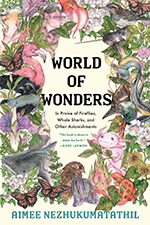 World of Wonders: In Praise of Fireflies, Whale Sharks, and Other Astonishments
by Aimee Nezhukumatathil
As a child, Nezhukumatathil called many places home: the grounds of a Kansas mental institution, where her Filipina mother was a doctor; the open skies and tall mountains of Arizona, where she hiked with her Indian father; and the chillier climes of western New York and Ohio. But no matter where she was transplanted—no matter how awkward the fit or forbidding the landscape—she was able to turn to our world’s fierce and funny creatures for guidance.
“What the peacock can do,” she tells us, “is remind you of a home you will run away from and run back to all your life.” The axolotl teaches us to smile, even in the face of unkindness; the touch-me-not plant shows us how to shake off unwanted advances; the narwhal demonstrates how to survive in hostile environments. Even in the strange and the unlovely, Nezhukumatathil finds beauty and kinship. For it is this way with wonder: it requires that we are curious enough to look past the distractions in order to fully appreciate the world’s gifts.
Warm, lyrical, and gorgeously illustrated by Fumi Nakamura, World of Wonders is a book of sustenance and joy.
 Sacred Nature: Restoring Our Ancient Bond with the Natural World
by Karen Armstrong
Since the beginning of time, humankind has looked upon nature and seen the divine. In the writings of the great thinkers across religions, the natural world inspires everything from fear, to awe, to tranquil contemplation; God, or however one defined the sublime, was present in everything. Yet today, even as we admire a tree or take in a striking landscape, we rarely see nature as sacred.
In this short but deeply powerful book, the best-selling historian of religion Karen Armstrong re-sacralizes nature for modern times. Drawing on her vast knowledge of the world’s religious traditions, she vividly describes nature’s central place in spirituality across the centuries. In bringing this age-old wisdom to life, Armstrong shows modern readers how to rediscover nature’s potency and form a connection to something greater than ourselves.